
Deconstructing Evangelicalism
Apocalyptic Language, Hell, and The Jewish Philosophy of History

I believe, as I have said many times, that evangelicalism is the result of a horrible reading of the Bible. As a result, evangelicalism has proven to produce bad fruit.
Bad theology equals bad ethics.
One area where evangelical theology is a poor reading of the Bible is how evangelicals in the pews are taught to understand apocalyptic literature. I am thinking of texts like Isaiah, Daniel, the Book of Revelation, and synoptic gospel texts like Matthew 24-25.
My thesis is simple.
Apocalyptic literature was a genre where Jewish writers taught a Jewish philosophy of history to their colonized or exiled Jewish readers. The events in Apocalyptic literature are events that happen in history and not at the end of history. The Jewish philosophy of history, which I believe is quite insightful, is that empires might last for 100s of years but they will fall. And, when they fall they fall rather quickly. Apocalyptic literature is an encouragement to be patient. Though you might not see Babylon fall or Rome fall, these empires will fall and their fall will come upon them like a thief in the night.
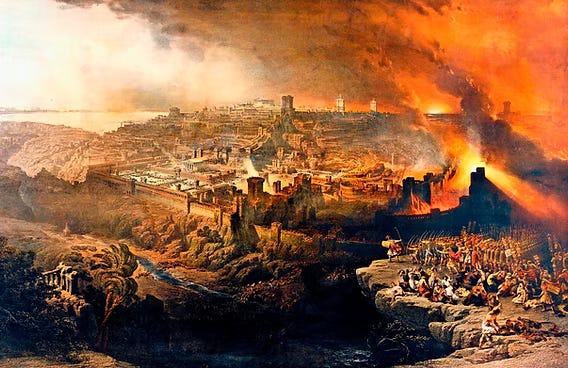
Like the poet said,
They say that Rome wasn’t built overnight
But if I remember right
It fell in broad daylight.
Another way to explain the Jewish view of history is in the saying made famous by Martin Luther King Jr.
The arc of the moral universe is long
But it bends towards justice.
Let me say this again. The events pictured in scripture’s apocalyptic literature are not events that happen at the end of history with God literally appearing in the sky and judging sinners with fire and brimstone. Instead, apocalyptic literature utilizes imagery that depicts how history will judge brutal empires because God has a plan within history to bend the arc of history slowly but surely toward justice.
Isaiah 13 and the End of the Space-Time Universe
A good example of Apocalyptic language is Isaiah 13. In verse 10, Isaiah writes:
The stars of heaven and their constellations
will not show their light.
The rising sun will be darkened
and the moon will not give its light.
This language is quoted many times in the New Testament including Matthew 24:29 and Revelation 6:13. Does this language refer to the end of the space-time universe or the end of history and the return of Christ and the fulness of the revelation of the Kingdom of God?
No.
This language poetically refers to the end of a historical period or an empire. As we will see, Isaiah is referring to the end of the Babylonian empire. Matthew 24 utilizes this language, but here, Jesus is speaking of the end of second temple Judaism. Jesus holds to the same philosophy of history as the writer in Isaiah. As Isaiah prophesied that Babylon will fall using apocalyptic language, so too Jesus spoke of the end of Second Temple Judaism and the era of the Kingdom of God.
Am I Alone in this Approach to These Texts?
Let’s look at how N. T. Wright speaks of how to interpret apocalyptic language. Here Wright is speaking of Jesus' use of the passage in Isaiah 13:
The language which they used to describe events…was what some people have sometimes called apocalyptic language that is to say things like the sun will be turned into darkness and the moon will be turned into blood and the Stars will be falling from heaven. Now, generations of Christians have thought that Jesus was predicting the end of the space-time Universe, however, when you trace that language back into the Old Testament and that bit about the sun and the moon and the stars comes from Isaiah 13. It isn't talking about the collapse of the space-time Universe. It's talking about the fall of Babylon which was the greatest Empire of the day.
In Isaiah, we have Apocalyptic language which is clearly talking about the fall of Babylon. So we can conclude that apocalyptic language is talking about a historic transition from one historical era to another. Instead, evangelicals commit a historical anachronism by insisting that these biblical texts should be read not like apocalyptic literature but like a scientific astronomical event like a comet hitting the earth or the sun ceasing to exist. Evangelicals are reading the texts as objective, observable, almost scientific events. They are using 20th-century eyes to read ancient texts.
Obviously, to apply a 20th-century scientific literalism to this type of language is to completely ignore the genre of Apocalyptic literature as used by Jewish writers.
In fact, understanding Jesus in Matthew 24-25 as referring to the end of one era and the beginning of a new era makes sense of the passages in literary context and historical context.
Matthew 24-25: As Apocalyptic Literature in Context
For centuries, Christians have read Jesus' use of Isaiah 13 in Matthew 24 as Jesus predicting the end of history and His return to set up the Kingdom of God in fullness. This end-of-history reading culminates with the sheep and the goats parable, where the sheep go to heaven and the goats go to hell. But, if we read this entire discourse as one unit, we see Jesus is speaking not of the end of history but the end of an era of history, namely, Second Temple Judaism.
Matthew 23 ends with the following lamentation of Jesus:
37 “Jerusalem, Jerusalem, you who kill the prophets and stone those sent to you, how often I have longed to gather your children together, as a hen gathers her chicks under her wings, and you were not willing. 38 Look, your house is left to you desolate. 39 For I tell you, you will not see me again until you say, ‘Blessed is he who comes in the name of the Lord.’”
Matthew 24 continues upon this theme concerning the future of Jerusalem.
Jesus left the temple and was walking away when his disciples came up to him to call his attention to its buildings. 2 “Do you see all these things?” he asked. “Truly I tell you, not one stone here will be left on another; everyone will be thrown down.”
So far, it is easy to see that Jesus is fixated on the topic of the fall of Jerusalem, the end of a historical period and not the end of history. Next, the disciples come to Jesus in private and ask for further clarification.
What gets confusing is that the disciples convoluted the fall of the temple with the setting up of Jesus as King of the World. At this point in the disciples’ understanding, they did not understand the cross, the resurrection, the ascension, and the coming of …..the Holy Spirit.
The text continues as follows:
3 As Jesus was sitting on the Mount of Olives, the disciples came to him privately. “Tell us,” they said, “when will this happen, and what will be the sign of your coming and of the end of the age?”
In context to what Jesus is talking about the question is straightforward. How will we know that one age has ended and the new era has begun? This question is central to the zeitgeist of Jesus’s historical context. The Jewish world was constantly asking “How will we know that our exile is over and the new reign of God is present?” How will we know that the “Law and the Prophets” era has ended and the “kingdom of God, the enthronement of the Messiah, has been inaugurated? Here I am riffing off of Jesus’ saying, “Until John the law and the prophets was proclaimed, but now the Kingdom of God and aggressive people are pressing into it.” (my paraphrase.)
In response to the disciples’ question, Jesus launches into Apocalyptic language. Now if we understand Apocalyptic language like in Isaiah 13 talking about the end of exile and captivity and the new reign of YAHWAY, that is the Day of the Lord, then we understand Matthew 24 and Matthew 25 as talking about the end of an era and not the end of all history.
Jesus continues quoting Isaiah.
28 Wherever there is a carcass, there the vultures will gather.
29 “Immediately after the distress of those days
“‘the sun will be darkened,
and the moon will not give its light;
the stars will fall from the sky,
and the heavenly bodies will be shaken.’
Here is how Michael Bird explains Matthew 24.
I understand that some regard vv. 24-27 (and what follows) as a second-coming text, but I think it uses apocalyptic language to describe the distress of the day and the deliverance of the Jerusalem church from the siege of Jerusalem.
All of this apocalyptic language and Day of the Lord language and the “appearing” of the Son of Man language NEVER is speaking of the final end of history but the end of an empire or an era. So Jesus is speaking of the great falling of Jerusalem like Isaiah was talking about the fall of Babylon.
What all these passages have in common is that they speak of how empires or eras come to a close. It happens violently and quickly.
It is for this reason that Jesus uses violent language about how people enter the kingdom of God saying,
“The Kingdom of God suffers violence and violent men (figuratively) take it by force”. Making radical changes and being a radical is not for the faint of heart.
To say evangelicalism is over and requires new leaders who completely tear down the old edifice and do not leave one stone upon another is not for the faint of heart.
Therefore, be loud, be thorough, say the quiet things out loud.
Figuratively speaking, be violent about it.
Yes, eras change.
Human institutions end abruptly.
Evangelicalism is over.
The crash has arrived… Oh, and as we will see in Matthew 25, as with religious eras, so too with nations who refuse to be hospitable to foreigners and neglect the poor.
But that is for next time.
IMHO, Evangelicalism needs to reimagine - rethink how we construct our theology.
https://reimaginenetwork.ning.com/forum/topics/rethink-how-your-worldview-drives-your-theology-and-ministry
And this doesn’t even account for the theological mess Evangelicals have made of the New Testament. This “Deconstucting Evangelicalism” is my favorite topic. 😇